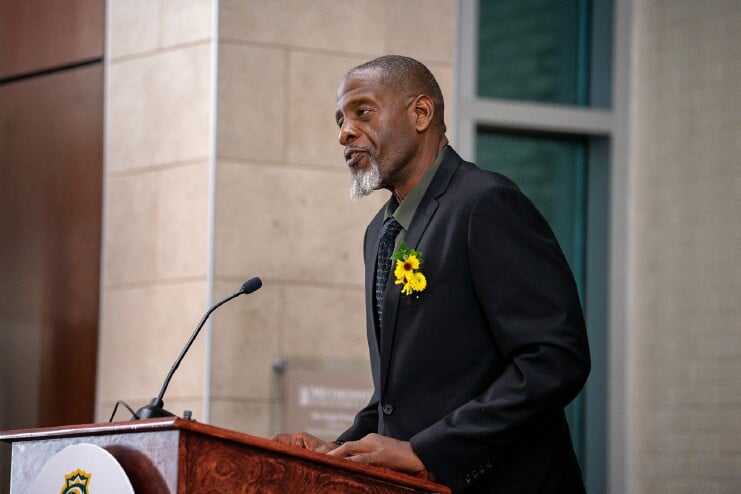
Before the records, the recognition as an All-American, and his 2025 Methodist University Athletics Hall of Fame induction, football wasn’t really in the plans for Randal “Chuck” Webster ’97. “I was just a regular old kid... trying to find his way and look for some purpose,” he said.
Before the records, the recognition as an All-American, and his 2025 Methodist University Athletics Hall of Fame induction, football wasn’t really in the plans for Randal “Chuck” Webster ’97. “I was just a regular old kid… trying to find his way and look for some purpose,” he said.
Bigger than most his age, Webster was encouraged to play football from an early age, but he did not get the chance until eighth grade at Hope Mills Junior High. Even then, the game didn’t come to him naturally.
“I was a late bloomer,” he said. “Some things were a little tougher for me.”
It was in high school at Douglas Byrd in Fayetteville that he fell in love with the game, and it began to take on new meaning. Under the late coach Bob Paroli, Webster began learning how to keep going when it would be easier to quit.
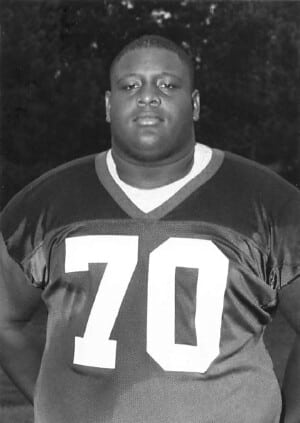 By Webster’s senior year, he had multiple scholarship offers, including opportunities at Livingstone and North Carolina Central University, but when people questioned why he chose a smaller Division III program, Webster said he understood what he needed at the time.
“Methodist University was the greatest thing for me, the smaller environment,” he said. “Administrators who really cared about the students.”
For Webster, the sense of belonging was immediate at MU. His campus experience resonated with him as personal, supportive, and patient, during a time when he admits he was not yet polished or fully locked in academically.
“I never felt any judgment,” Webster said. “They were very patient with me.”
That support was important, because Webster faced a few rocky moments that pushed him to pause and take time to reflect and reset.
“The last thing I wanted to do was disappoint my mom and disappoint so many people that depended on me,” he said.
Once he found himself, he said everything started moving in his favor. Football improved. Academics improved. Life made more sense.
“I’m so grateful for Methodist University because of how patient they were with me,” Webster said, “and who they helped mold me to be.”
Dave Eavenson, now vice president & director of athletics at MU, was a student assistant coach at the school from 1993 to 1996, and he said that the growth was evident in Webster over time.
“The thing I remember most about Chuck was his strong work ethic, what a great person he was, and how good of a teammate he was,” Eavenson said. “He led by example every day in how he worked and how he carried himself on the field.”
Holding the Line
On the field, Webster built a Hall of Fame career that helped define the winningest era of Methodist University football. An offensive tackle throughout his time at MU, he said he moved from right tackle to left tackle his senior season, a shift that forced him into a more demanding role.
“At first, I remember thinking I didn’t like that at all,” he said. “It’s a whole different dynamic.”
Instead of fighting the change, Webster embraced it. It became one of the lessons he still teaches today.
“Only the stuff that makes you uncomfortable makes you grow,” he said. “Growth comes through trials, through pain, and some overcoming.”
Eavenson says that willingness to adapt reflected Webster’s leadership.
“Whatever was best for the team, Chuck was willing to do,” Eavenson said. “He adapted, adjusted, and put the team first. That’s outstanding leadership.”
Webster credits that mindset, along with team culture, for the success of the 1997 squad that went 9-1. He described that group as a brotherhood, built on standards that carried over from year to year.
“We set the standard,” Webster said. “We all worked extremely hard together. We expected to win every game.”
Paying It Forward
In addition to his athletic accomplishments, Webster graduated as a Physical Education major. His winning mentality translated far beyond football.
“Everywhere Chuck has been, he’s been consistent in how he leads and how he carries himself,” Eavenson said.
Today, Webster’s story continues where it started, in Fayetteville. At Trinity Christian School, he wears many hats serving as a high school administrator and teacher, and he coaches basketball, track, and of course football.
His legacy stretches beyond the field at MU. Trinity Christian named its football field after him, an honor Webster called humbling and, at first, a little surreal.
“I kind of felt funny about it at first,” he said, referring to the fact that most of the time honors like this come posthumously. “I feel like I’m just getting started.”
Webster said the name on the field is not about status. It is about responsibility, expectations, and the kind of young men he wants to help shape.
“The product isn’t just great athletes,” he said. “It’s solid young men, future stellar husbands, fathers, and leaders. That needs to be the product off that field.”
When Webster talks to students preparing for college, he does not pretend he had it all figured out. Instead, he uses his own mistakes as a guide.
“Make sure you surround yourself with people who have the same goals as you,” Webster said. “Things became a lot easier when I did that.”
Methodist University, he said, gave him the space to mature, the support to reset when things went off track, and the confidence to become who he needed to be.
“I don’t know if everyone realizes how much I needed Methodist University,” Webster said. “But I do.”
Now, decades later, those lessons shape how he leads, how he coaches, and how he gives back, from the field that carries his name to the students he mentors every day.
For students standing where he once was, still figuring things out, Webster’s message is simple: Give yourself a chance.