For Cherrell Ray ’25, the journey through Methodist University’s Social Work Program was not just about earning her degree. It was a balancing act to prove to herself that she could come back to the classroom as a non-traditional student and juggle a full-time career with hopes of stepping into a new career built on service.
For Cherrell Ray ’25, the journey through Methodist University’s Social Work Program was not just about earning her degree. It was a balancing act to prove to herself that she could come back to the classroom as a non-traditional student and juggle a full-time career with hopes of stepping into a new career built on service.
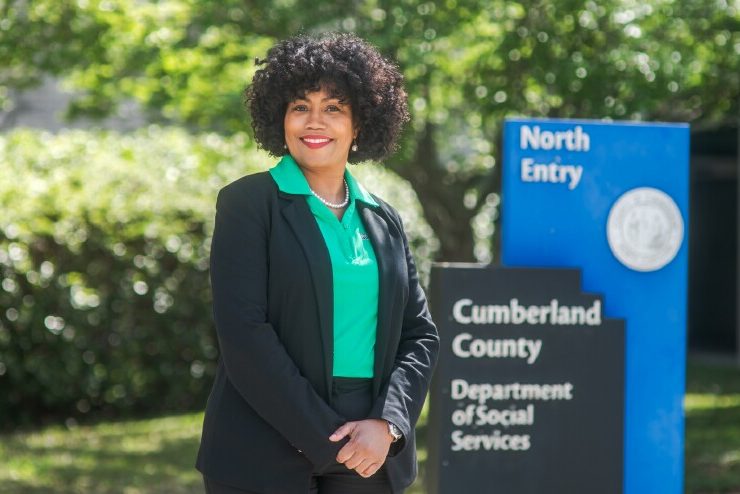
By the time Ray crossed the Commencement stage at the Crown Coliseum in Spring 2025, she had done just that, transitioning from one career, to an MU Monarch student, and now to a professional working with Cumberland County Department of Social Services.
Ray’s journey is a product of how the Social Work Program at MU prepares students not just for graduation but for them to transition directly into a profession of service working within their communities.
The Balancing Act
Before coming to Methodist University, Ray worked as a school registrar with Cumberland County Schools. During the COVID pandemic, at a time of uncertainty and transition, she was led to a role in Admissions at MU. From there, she began taking classes as a Monarch, and balancing classes, a full-time job, and life outside of both was not easy. She remained disciplined and determined, and she kept high expectations for herself.
Lynn Cannady, administrative assistant for Methodist University Admissions, says Ray has always been proactive, staying on top of her work.
“Cherrell worked hard to balance her work in Admissions, her classwork as student at Methodist University, as well as her personal life,” Cannady said. “She kept on top of it from the beginning of the semester. She was that first voice of reassurance to prospective student callers, as well as the first bright smile they saw upon entering Stout Hall (home of the Admission’s Office). The first impression she gave was always positive.”
Ray said she kept one goal in mind.
“Just being able to graduate, that’s what pushed me and what motivated me,” she said.
Her discipline and determination were a part of how she approached every part of her experience.
Pushing Past Doubt
In the classroom, Ray brought the same focus she carried into her job. She made the most of every opportunity available, using lunch breaks to attend class, completing assignments after work, and utilizing additional support from resources like the Writing & Tutoring Center.
Despite her discipline and consistency, one of Ray’s biggest struggles was not academic but internal. Coming back to school as a non-traditional student, she often thought about her age and how she compared to others in the class.
“I was almost always the oldest one in the classroom,” she said.
At times, she questioned herself and whether she could keep up in areas like technology, discussion, and just adjusting back into a classroom environment. That doubt, however, did not reflect in her performance. She was doing more than keeping up − she was excelling.
One of her professors, James Phelan, M.Ed., adjunct instructor of Sociology, noticed the time and effort she was putting in early on.
“The Canvas website we use for online learning keeps track of a student’s online time,” Phelan said. “I realized that Cherrell was putting in multiple hours into her classwork, over and above any of her fellow class members.”
Phelan also noticed that even with the hours of study, she continued to manage work, school, and other responsibilities without seeking special treatment.
“I realized that she was working at MU and providing for her family; she was paying her own way but never asking for special favors or exemptions,” he said. “I was so impressed with her work that I nominated her for our Honors Program,” he said.
What she initially saw as a disadvantage became one of her greatest strengths, bringing maturity, perspective, and discipline into the classroom.
From Preparation to Practice
Now working with Cumberland County Department of Social Services, Ray is applying the skills and knowledge she gained at Methodist University into her transition into the field. The foundation she built in the program shows up in her day-to-day work, from understanding policies and ethics to approaching situations with empathy, professionalism, and free of judgment. Her role places her in direct contact with individuals from all backgrounds, each facing different challenges and circumstances.
“You’re still coming in contact with a lot of the community, with people from different backgrounds,” she said. “People who are homeless, people who maybe worked in a corporate world and have lost their jobs and they need services.”
The program prepared her not just with knowledge, but with perspective, how to listen, how to engage and connect individuals with the resources they need.
Having spent more than four decades in the field, Phelan said that it was clear Ray had the talent for this line of work before she entered the profession.
“I came to know instinctively which social workers were ‘born to serve’ and would be the agent for change that a child or young adult needed at a critical time in their lives,” he said. “I honestly felt that Cherrell has a gift for this career.”
For Ray, the calling is personal.
“Social work was something that kind of stood out to me because, growing up I lost my mom at 21 to a domestic violence situation.” she said. “I just wanted to be there to be able to help somebody else to kind of maneuver through some of those things.”
Stepping into Purpose
Ray’s journey embodies the bigger picture of Methodist University’s Social Work Program, Cannady said.
“Cherrell’s journey shows that Methodist University prepares students not only academically but also personally for careers in fields like social work.”
Her path highlights a transition from uncertainty to direction, from student to professional, and from personal experience to purposeful work.
“I’d like to see myself working in a hospital as a healthcare social worker,” she said.
Experiencing both sides of Methodist University, working with prospective students while also being one, continues to guide Ray’s journey forward. Phelan says that kind of perspective is exactly what the field and the classroom need more of.
“A part of me always continues to hope to see Cherrell on one of my class rosters,” he said.
The experience and perspective gained from her journey is something Ray now passes on to other Monarchs and prospective students, just as she did in Admissions.
“Take advantage of everything that’s available to you,” she said. “It’s there for your overall experience so that you can achieve your goal.”
For more information on Methodist University’s Social Work Program, including requirements and career pathways, visit methodist.edu/academics/program/social-work/.