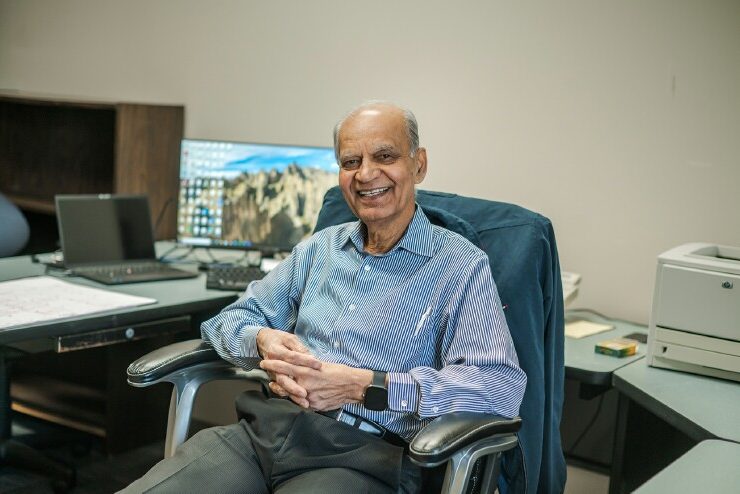
In May 2025, Dr. Shivappa Palled will wrap up his 37th year teaching at Methodist University. Undergraduate Mathematics may not have changed much in those 37 years, but students and the methodologies used to teach them certainly have.
In May 2025, Dr. Shivappa Palled will wrap up his 37th year teaching at Methodist University. Undergraduate Mathematics may not have changed much in those 37 years, but students and the methodologies used to teach them certainly have.
While current students and 21st-century alumni know Palled from teaching Math, it may surprise some to learn that, although his Ph.D. is in Mathematics, it was the opportunity to teach Computer Science that led him to then-Methodist College in 1988 from the State University of New York at Potsdam, where he had held an assistant professor position in Mathematics for six years.
“They were looking for people to teach Computer Science [in higher education] at the time,” he said.
Since Computer Science was a developing field in the mid-to-late 1980’s, there was a shortage of qualified bachelor’s-level Computer Science instructors. To meet this need, Palled enrolled at the Institute for Retraining in Computer Science at Clarkson University in Potsdam. Once his continuing education program was complete, he joined the faculty at Methodist University.
 Beginning his career as an assistant professor, he taught two Mathematics and two Computer Science courses each semester until 2001, when he transitioned to teaching Math full time. Although he enjoyed teaching Computer Science, the regional accrediting body, now known as SACSCOC, required MU to have more faculty with terminal degrees in Computer Science. Around that time, the Department of Mathematics & Computer Science split into two departments. He had become department chair in 1996, and he remained chair of the Mathematics Department until 2020.
One of the things Palled is most proud of concerning his tenure as department chair is that the department faculty suffered little turnover through the years. Two of his retired colleagues also had tenures of 30-plus years – Patricia Jones (30 years) and Dr. Lewis Walston (33 years) – and his current colleague, Dr. Peggy Batten, has been in the department for 32 years and counting.
Palled recalls that the generation of students coming through the University in the late 1980s and early 1990s had different demands on their attention than today’s students do, as today’s students’ phones connect them to the Internet 24/7.
“At that time, students didn’t have as many distractions,” he said. “They paid attention during class lectures, took notes, and asked questions in a different way than they do now.”
Times changed, technology upgraded, and a new generation of students who had grown up with technology in school and home began enrolling at MU. Palled has adjusted his approach accordingly, including technology-integrated assignments in his courses on the Canvas learning management system.
“Today, students are visual learners,” he said. “They don’t learn like previous generations; they much prefer to learn on their own.”
Palled teaches most students core classes, such as College Algebra and Finite Mathematics, and for students going into Engineering and Computer Science, Calculus and Discrete Mathematics. For Mathematics majors, he has taught Modern Algebra, Differential Equations, Linear Algebra, and Advanced Calculus. Although the department is as busy as ever, there are not as many pure Mathematics majors as there once were.
“There used to be a great many Mathematics majors,” Palled said. “At this time, most of the current students that we are teaching at Methodist University are going into Engineering, Data Science, Computer Science, or Computer Information Technology.”
Data Science is the newest among these particular majors at Methodist University, and all of which are housed in the College of Business, Technology, & Professional Studies. Although Data Science shares the department with Mathematics, Palled teaches just the foundational Math courses needed for the program, and that’s just how he likes it.
Getting students to understand the fundamentals has always been what’s inspired Palled’s teaching philosophy.
“I just want students to learn, and especially understand concepts,” he said, “and not merely just try to get a grade.”
One thing, he said, that was just as true when he began at MU as it is now is that, while there are students in his classes that don’t plan to pursue a career in math, there are always students who are, and he wants to keep them motivated to succeed. It’s what has kept Palled motivated and successful, as well, for nearly 40 years at MU.