The third of a four-part series (as it appeared in the most recent MU Today Alumni Magazine) highlighting the Colleges of Methodist University
The College of Arts, Humanities & Sciences (CAHS) highlights the core of the educational foundation at Methodist University. In the CAHS, students learn how to think, communicate effectively, gain a better understanding of the world around them, and apply that knowledge to everyday life. CAHS brings together discipline in ideologies, creativity, systems, people, and science. Whether students are doing laboratory research, analyzing political systems, writing arguments, or engaging with media arts, they are building skills that shape both their professional and personal lives.
The divisions within CAHS include Communication, Composition & Rhetoric; Fine & Performing Arts; Humanities; Justice & Military Studies; Natural Sciences; and Social Sciences. Note also, the Honors Program and Interdisciplinary Studies. Together, they are a strong academic foundation for students at Methodist University.
Communication, Composition & Rhetoric
In the Division of Communication, Composition, & Rhetoric, students develop confident and capable voices in writing and speaking.
“Beginning with their required first-year writing courses, students experience mentorship and expert instruction in the basics of writing and speaking in academic and professional settings”
Under the leadership of Assistant Professor Sonali Kudva, Ph.D., the Communication & Media Program prepares students in strategic and interpersonal communication, journalism, content creation, audio and video production, public speaking, and more.
Faculty members such as Corbett and Kudva mentor students on print publication, media projects and writing-intensive coursework designed to build confidence, persistence, and interpersonal communication skills. This division prepares students for careers in media, marketing, public relations, and leadership.
Learn more at methodist.edu/ahs/ccr.
Fine & Performing Arts
The Fine & Performing Arts Division creates a tremendous opportunity for all students at Methodist University to have a chance to experience and explore the arts, whether as majors or through electives.
While Graphic Design serves as the primary degree program, the division’s studio art, art history, music, and photography courses also create strong entry points for students across the MU campus to explore visual literacy, cultural understanding, and artistic expression.
Classrooms function as active studios and collaborative spaces. Students are not only studying art, they are making it. Graphic Design majors complete client-based projects, work with community partners, and graduate with portfolios ready for the next steps in their career. Studio art students develop technical skills while refining their personal style. In music and art history courses, students analyze form, performance, and cultural context, strengthening both their creative and critical
thinking abilities.
“Mentorship is the heart of our division. Our faculty know their students well and are deeply invested in their growth, helping them build confidence and a strong creative voice.”
The Makerspace
The Makerspace – supported in part by the William Bethune Fund for the Arts – is a fully functional creative lab open to students, faculty, and staff.
“The Bethune Makerspace is a campus-wide resource open to all students and faculty. It creates an environment where ideas can be explored through making. By lowering barriers to access and encouraging collaboration, the Makerspace fosters curiosity, technological and material exploration, and creative problem-solving across disciplines.”
Organized into stations, the Makerspace includes sublimation printing, five 3D printers, hot-wire foam cutting, a heat press, vinyl cutting, vacuum forming, and a laser engraver. Students create prototypes, signage, packaging, tools, and design projects all in-house.
“Everybody needs to know they can use it,” said Andrew Prieto, assistant professor of Art and visual art exhibition coordinator. “There are practical applications for almost anything you’re working on. You don’t have to outsource it. You can come in here and make it.”
Student work shapes the visual and cultural life of campus through exhibitions, performances, and collaborative projects. The arts also connect with the other disciplines in the CAHS, through communication, leadership, and even science, by helping students translate their ideas and concepts into visual and physical forms. The Makerspace is one place those connections are tangible.
Learn more at methodist.edu/ahs/fine-performing-arts.
Humanities
In the Humanities Division, students learn to use reading, writing, and discussion to analyze and support their ideas. The courses in English; History; Religion, Ethics & Meaning; and Global Studies allow students to take a closer look at history, belief systems, and cultural movements. Through their studies, they are expected to build arguments, ask questions, and use sources to support their thought processes.
Division Head and Professor of History Dr. Patrick O’Neil says that one of the most valuable skills MU students gain is the ability to interpret information that can be both complex and many times also conflicting.
“What students get most especially from studying in Humanities is the ability to make sense of complicated data,” he said. “The sources that historians deal with (laws, orders, propaganda from all sides) are the same things that it’s most useful to be able to interpret today.”
That kind of preparation is intentional. Faculty work closely with students as they design research projects, lead discussions, and refine their arguments.
The goal is not just content knowledge but confidence in analysis. Whether students move into graduate study, law, education, or public service, they leave with the ability to examine information carefully and respond with clarity.
Learn more at methodist.edu/ahs/humanities
Justice & Military Science
The Justice & Military Studies Division prepares Methodist University students for careers in criminal justice, forensic science, legal studies, and military leadership. Students utilize classroom knowledge with professional experiences that prepare them for careers in justice, law, and military leadership helping students navigate law, policy, ethics, and responsibility with deeper understanding. and confidence.
Students in the division are often published, make presentations, and attend conferences where they learn professional expectations and have a chance to network. This is meaningful engagement outside of the classroom.
Each faculty member brings distinct expertise and professional experience to the division and it graduates students with published work, conference experience, and a clear understanding of their role in their profession.
Learn more at methodist.edu/ahs/justice-military-science.
Natural Sciences
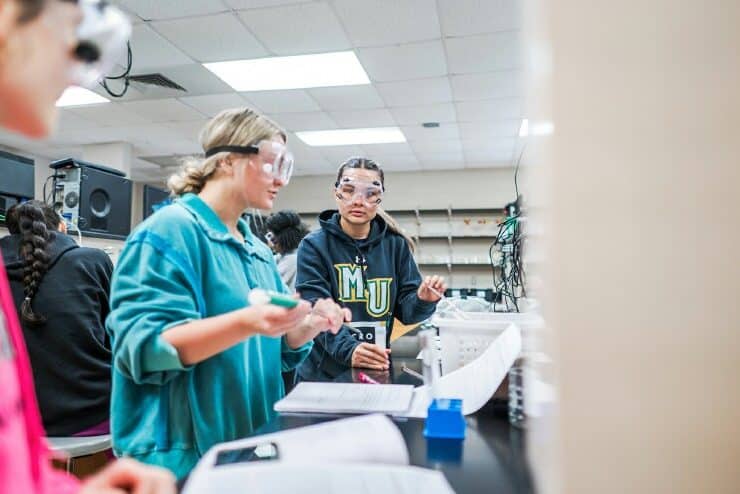
In the Natural Sciences Division, students explore biology and chemistry through experimentation, applied research, and close faculty mentorship. The division includes five Chemistry faculty members and four Biology faculty members whose areas of specialization range from ecology and insect biology to nuclear magnetic resonance, atomic absorption spectroscopy, and computational chemistry.
“Our faculty at MU have multi-disciplinary backgrounds and expose students in their early careers to research methodologies and practices. Not only are they wonderful educators, but they are science investigators at their heart.”
Students majoring in Biology can pursue Pre-Med and Pre-Veterinary concentrations, while Chemistry majors explore Biochemistry and Forensic Science tracks. Coursework emphasizes experimentation and analytical thinking, but instruction extends far beyond lectures.
Chemistry students operate an 80 MHz table-top NMR spectrometer and train in capillary electrophoresis and atomic absorption spectroscopy under experienced faculty such as Stephanie Hooper-Marosek, Ph.D. Computational chemists Cu Phung, Ph.D., and Tekalign Debela, Ph.D., who introduce students to advanced software approaches for solving chemistry problems.
In Biology, students work in molecular facilities and are currently building a zebrafish aquarium to support anatomy and physiology study.
Antharam says that early exposure to research builds confidence and clarity for the future.
“Mentoring our undergraduate students in areas of STEM has landed our graduates into some of the most prominent graduate schools and medical schools in the country,” he said.
Inside the Hendricks Science Complex, faculty and staff operate with collaboration at the forefront. Student growth is prioritized intellectually and emotionally. The result is rigorous scientific preparation paired with sustained mentorship, an experience that continues to shape graduates long after they leave MU.
Learn more at methodist.edu/ahs/natural-sciences.
Social Sciences
The Social Sciences Division centers on one question: How do people live, work, and govern together?
Psychology, Sociology, and Political Science each approaches that question differently while sharing a focus on community, behavior, and systems.
“Our division is engaged in the science of people and society. That means we are deeply interested in how people work together and how community happens.”
In Political Science, students study power and the institutions that shape their lives. They travel to Washington, D.C., and Raleigh to meet with lawmakers, intern with the City of Fayetteville and other organizations, and study abroad.
Psychology students pursue counseling and research opportunities, while Sociology students examine social structures and examine community health issues. A new Public Health major coming this fall will expand those connections for MU students within the Fayetteville community.
Learn more at methodist.edu/ahs/social-sciences.
Interdisciplinary Studies Programs
Not every student’s path fits neatly inside a single division. Some students aim to connect various philosophies across departments. Programs within the College of Arts, Humanities & Sciences are intentionally designed to cross boundaries, and Interdisciplinary Studies gives them the space to do so.
Interdisciplinary Studies at MU pulls on philosophy, social sciences, communication, and history to create degrees and minors that cultivate critical thinking and reflect how issues show up in life. The minors in Black Studies and Women’s Studies invite students from all majors to examine how identity, culture, and history intersect. These programs challenge students to think more in depth about power, representation, and lived experience.
The Bachelor of Arts in Professional Leadership & Ethics is designed for online students who want flexibility.
“The flexible degree pathways support career advancement by building on students’ prior learning and professional experience. Our interdisciplinary programs draw on multiple fields to prepare students for today’s complex world.”
At MU, Interdisciplinary Studies gives students room to shape their education around who they are and where they are headed. Within CAHS, it exists for students whose interests do not fit inside one major. The program allows them to combine ideas, experience, and ambition into a degree that meets them where they are and supports their goals.
Honors Program: A Community Within a Community
The Honors Program amplifies the academic experience for students who are motivated to excel. The program is for current students with a minimum 3.0 GPA and incoming freshmen with a minimum 3.2 GPA (on a 4.0 scale.) It encourages interdisciplinary thinking, discussion, and intellectual engagement beyond standard curriculum.
“The Honors Program is a real community within a community: ambitious, engaged students gathered together to explore a huge diversity of perspectives and think through difficult problems. It trains students not only to think brilliantly but to talk brilliantly, too, preparing them for the kinds of conversations they’ll have in graduate school and in life.”
To learn more about the CAHS, visit methodist.edu/academics/ahs.