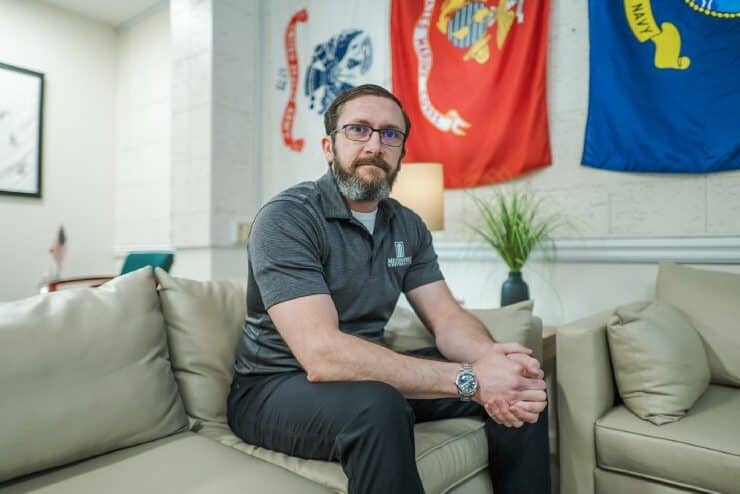
When Eric Palomar retired from the United States Army after 21 years of service, he found himself at a crossroads many veterans quietly face. After two decades as a Green Beret and Special Forces medic, his life had been defined by discipline, sacrifice, and the purpose and responsibility that come with wearing the uniform. Stepping into civilian life meant asking himself, who was he outside of the camouflage?
When Eric Palomar retired from the United States Army after 21 years of service, he found himself at a crossroads many veterans quietly face. After two decades as a Green Beret and Special Forces medic, his life had been defined by discipline, sacrifice, and the purpose and responsibility that come with wearing the uniform. Stepping into civilian life meant asking himself, who was he outside of the camouflage?
“You wrap up a lot of your identity in what you do,” Palomar said. “As a soldier, that’s a big part of your purpose and your self-worth.”
His next steps would be inspired not by the brotherhood of the military, but by his family in fatherhood.
Fayetteville has been home to Palomar since the early 2000s. A proud girl dad, he and his wife, who works on Fort Bragg, have raised their three daughters in the city. Their family depends on a network of care providers they’ve fought hard to build, so when he began considering his next chapter, he knew it had to start close to home.
Palomar enrolled at MU as a non-degree-seeking online student while completing most of his courses through American Military University. With his prerequisites underway, he began mapping out the next step toward a healthcare career.
The Methodist University Physician Assistant Program was already familiar to him. Palomar encountered MU-trained providers during his deployments, all of whom were highly capable, confident, and prepared. So, when he began considering a career in healthcare, MU rose to the top of the list.
“Every provider I interacted with spoke highly of the caliber of MU’s PA students,” he said. “And the program has such strong clinical partnerships. That really appealed to me.”
He didn’t always plan on a future in healthcare. In fact, five years ago, he said he would have vehemently denied the idea of even returning to school. That changed when he became a parent to a child with complex medical needs.
“You just look at healthcare differently when it’s your own child,” he said. “You wait six months for an appointment, and so much hope, fear, and uncertainty hang on that moment.”
The difference between rushed care and feeling like “just another box for a provider to check” versus providers who made him feel seen, reshaped everything. “That’s the kind of provider I want to be,” he said. “Someone who cuts through fear with confidence, competence, and knowledge.”
It’s why he’s drawn to pediatrics, and especially to caring for children with special needs. “Kids are kids everywhere; no matter what country I was (deployed) in, they were always the best part of humanity,” he said.
From Service to Civilian to Student
Returning to academia after 20 years was intimidating, but Palomar found that military discipline translated well into University life.
“I find a lot of peace and tranquility in studying,” he said. “For that hour, it’s just you and the task at hand. Everything else melts away.”
He welcomed a challenge, too, and he found it in Dr. Rob McCandless’s Biology class. “He made you work for it, and because of that challenge, you absorb the material so much more deeply.”
Even while completing most of his courses online, Palomar has become a leader in MU’s veteran community as president of Chi Delta Chi, the honor society for military-affiliated students and their families. “There’s a certain language we speak, certain experiences we share,” he said.
Rocio Serna, coordinator in the Military & Veterans Services Center, says his leadership is felt immediately.
“Eric carries professionalism into everything he does. His ‘yes’ means ‘yes’, and his ‘no’ means ‘no’. We can always count on him.”
To fellow veterans considering a new path, he offers simple advice: “Don’t be afraid to challenge yourself. Break it down one piece at a time.”
As he works towards becoming a physician assistant, Palomar is still serving, just in a different uniform and for a different kind of fight.