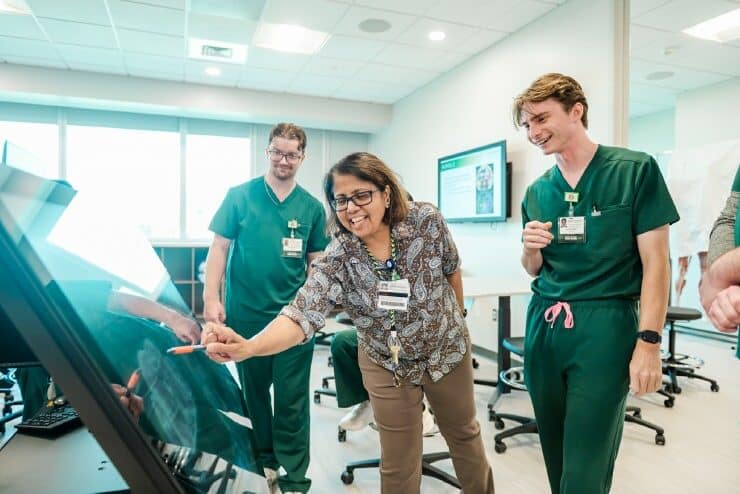
The Methodist University Cape Fear Valley Health School of Medicine has established a Women in Medicine and Science (WiMS) standing committee, creating a formal structure to support the professional development, advancement, and leadership of women faculty. Pictured here is Mary Sukumar, MD, director of Simulation Education.
The Methodist University Cape Fear Valley Health School of Medicine has established a Women in Medicine and Science (WiMS) standing committee, creating a formal structure to support the professional development, advancement, and leadership of women faculty.
The committee launches at an important time for the Methodist University and Cape Fear Valley Health as they continue building a growing academic medical community. Through mentorship, professional development, networking and leadership opportunities, WiMS will help create pathways for women faculty to grow, contribute and lead.
For Elza Mylona, PhD, senior associate dean for Faculty Affairs & Faculty Development and interim chair of the WiMS Committee, the initiative builds on more than three decades of experience supporting women in academic medicine and science.
“I have seen considerable progress during my career, but I have also learned that progress does not happen simply because more women enter medicine,” Mylona said. “It happens when institutions intentionally create opportunities for women to be mentored, sponsored, recognized, promoted and prepared to lead.”

National data underscore the continued need for this work. According to the Association of American Medical Colleges’ 2023–24 report on women in academic medicine, women represent 45% of full-time medical school faculty, but hold 29% of full professorships, 25% of department chair positions and 27% of medical school dean roles. The report identifies mentorship, sponsorship, promotion, advancement, and leadership development among key priorities for institutional Women in Medicine and Science programs.
WiMS will build on that foundation while responding to the needs of the School of Medicine faculty community. Its work will focus on mentorship and sponsorship, career and leadership development, professional networking, recognition of faculty accomplishments, and opportunities for greater involvement in academic medicine and institutional service.
Just as important, the committee will listen. Faculty at different career stages across different disciplines may have different needs, and WiMS will use those perspectives to help shape relevant programming and opportunities.
“Women do better work when they have people around them to share ideas and support each other. These fields can be isolating, especially early in a career. A good network gives you someone to call when a project stalls or when you need honest feedback,” said Meredith Gronski, OTD, dean, College of Health Sciences & Human Services.”
“It also opens doors that might otherwise stay closed. Creating those spaces on purpose is one of the most supportive things we can do to help women grow and lead in health care.”
The committee has already begun building community through its inaugural Women in Medicine and Science brunch, featuring . Strasser, a respected leader in academic medicine and a longtime advocate for the advancement of women in medicine and science, brought decades of experience and perspective to the conversation. The event marked the beginning of an ongoing effort to connect women faculty, create opportunities for professional growth and encourage greater participation in academic medicine.
Faculty Affairs & Faculty Development will provide administrative support while WiMS remains faculty-led, allowing members to identify priorities and help shape initiatives across the School of Medicine and health system.
“Women have made great strides in medicine, but we still face obstacles, particularly when it comes to leadership. While more women are entering medicine, we remain underrepresented at the leadership level,” said Victoria Kaprielian, a retired physician and longtime member of the medical community.
“I’m hopeful that we continue moving in a good direction and that the academic community continues to create opportunities for women to grow, lead and support one another.”
As the School of Medicine and its academic health partnership continue to grow, the establishment of WiMS provides an opportunity to intentionally build a culture where women faculty can see pathways for growth, leadership and meaningful contribution.
The work begins with community, but its impact can extend across the institution, strengthening connections, creating opportunities, and helping shape the future of academic medicine at Methodist University and Cape Fear Valley Health.