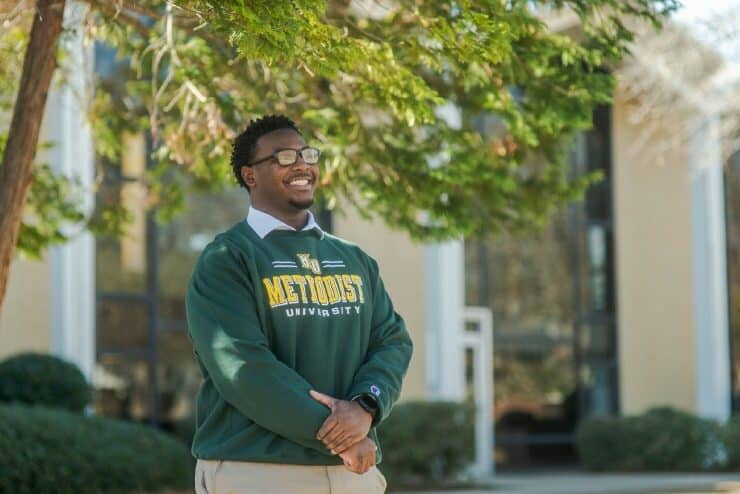
When considering colleges, Fayetteville native Jeremiah Sansbury did not plan to stay close to home. In fact, that was the one thing he was trying to avoid. Before his visit to the MU campus, he remembers telling his mother, “I think I’m going to like it, and I’m going to be too close to home.”
When considering colleges, Fayetteville native Jeremiah Sansbury did not plan to stay close to home. In fact, that was the one thing he was trying to avoid. Before his visit to the MU campus, he remembers telling his mother, “I think I’m going to like it, and I’m going to be too close to home.”
After visiting campus, something shifted for the Pine Forest High graduate.
“It felt like a different world,” Sansbury said. “It didn’t feel like I was just staying home.”
He felt he could thrive at MU, a perspective that would matter more than he imagined.
A Turning Point
A talented football player, Sansbury expected college athletics to define his campus experience. As in high school, he figured sports would open doors. Then, three games into his sophomore season, he tore his ACL.
“I was absolutely distraught,” he said. “But then I thought ‘If I couldn’t lead on the field, I was going to lead somewhere else’”
That injury forced him to reconsider what was important to him, and sitting still wasn’t an option. A guest speaker in his Marketing class introduced him to the business side of leadership and sport. The classroom conversation led him to explore extracurriculars beyond athletics, starting with the Student-Athlete Advisory Committee and eventually expanding into campus leadership. His setback became a turning point.
Platform for the People
Today, Sansbury’s presence stretches across campus. He serves as president of the Sport Management Club, vice president of the Greek Council, a member of Athletic Senate within the Student Government Association, an E-board member of SAAC, a Resident Assistant in North Hall, and an intern with the Monarch Student Marketing Agency (MSMA). He is also a Spring 2025 initiate of Alpha Phi Alpha Fraternity, Inc., and serves as social chair for the Phi Gamma Chapter.
Even with his heavy involvement, Sansbury says that leadership is not about titles.
Leadership, for him, is less about holding a position and more about presence, approach, and inclusion. He believes leadership lies in whether people feel valued, treating every room, every meeting, and every person with the same level of respect.
“My platform is the people,” Sansbury said. “I want to make everyone feel heard, feel seen. No one deserves to feel left out. Even the least important person on paper should feel just as important.”
His growth and development did not happen alone.
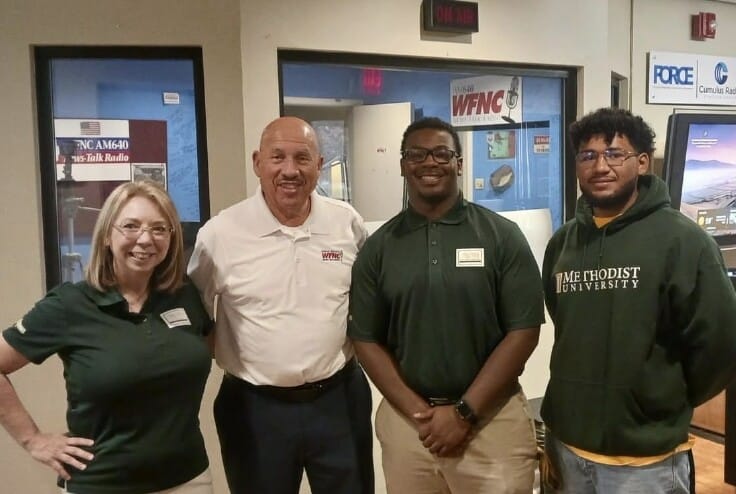
“Definitely shout out to (Assistant Professor of Marketing) Sam Inczauskis for taking a chance on me,” Sansbury said. “I didn’t even see it within myself.”
Inczauskis, who works closely with Sansbury through the MSMA, describes his impact as both strategic and personal.
“Jeremiah exemplifies servant leadership through his work in the Monarch Student Marketing Agency, where he provides strategic support to community partners while elevating his peers,” Inczauskis said. “As a dedicated student-athlete and active campus leader, he represents our University with integrity, discipline, and a deep commitment to making a meaningful impact.”
Inczauskis said Sansbury approaches every project with initiative and thoughtfulness, ensuring community partners receive meaningful support while creating space for others to grow alongside him.
“There is pressure,” he said. “Pressure makes diamonds.”
More Important to Be Nice
Sansbury understands that campus leadership is temporary. Positions change. Titles rotate. Graduation comes.
“If I can leave a space better than I found it, that’s enough,” Sansbury said.
Looking ahead, he hopes his time at Methodist University will be measured not by how many roles he held, but by how he made people feel.
“I want to be remembered as someone who made MU better than he found it,” he said. And he understands growth comes at a cost.
“As many wins as you see, there have been equally the same amount of losses,” he said. “When you make the change and when you win, it’s worth it.”
His journey reflects that. An injury redirected him, a classroom conversation sparked a shift, and campus visit changed his perspective. If he had to express his approach to leadership in one sentence, it would be:
“It’s nice to be important,” he said, “but it’s more important to be nice.”
For more information on student organizations and leadership opportunities at Methodist University, visit methodist.edu/get-involved/organizations/.