A Four-Part Series | Part 4: Caliber of Faculty
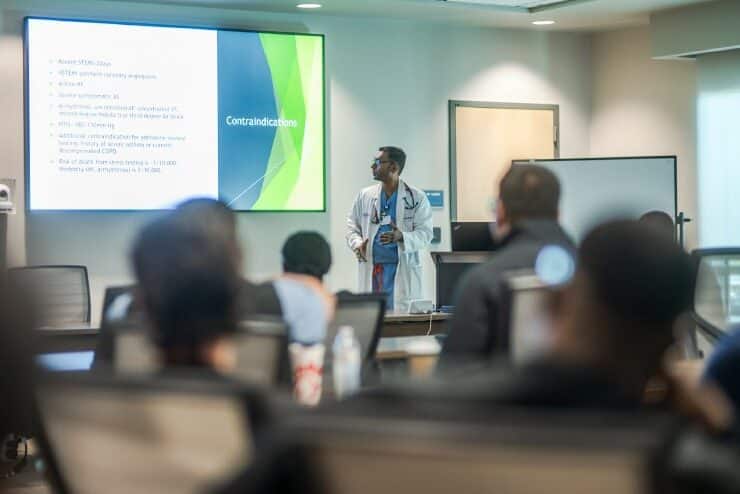
When choosing a medical school, whom you learn from matters just as much as what you learn. At the Methodist University Cape Fear Valley Health School of Medicine, faculty are more than just educators. They are mentors, clinicians, and future partners in students’ medical education and career.
What sets the School of Medicine apart is how closely students work with faculty, both in the classroom and in clinical settings built through one health system, starting early and continuing throughout medical school.
Clinical Education Rooted in Community
One of the biggest tools of faculty engagement at the School of Medicine is the school’s direct pipeline with Cape Fear Valley Health. That means learning is done all in one place, with students and faculty working hand-in-hand in the new $65-million School of Medicine building with state-of-the-art classrooms, clinical settings, auditoriums, student areas, and more. Rather than rotating through non-new network systems, students will complete all third-year clerkships locally and within a dedicated health system. This allows them to build meaningful, sustained relationships with faculty, residents, and clinical staff.
Third-year clerkships will include six-week rotations across every core specialty, including Internal Medicine, Surgery, OB/GYN, Pediatrics, Psychiatry, Family Medicine, Neurology, and Emergency Medicine. This builds a well-rounded foundation while allowing faculty to observe growth in students over time and still have access to mentor and teach them.
Cape Fear Valley Health hosts multiple residency programs, and students will also have built-in audition opportunities on campus. These early opportunities allow students to explore specialties, build relationships, and strengthen their residency pathways within a system where faculty know them beyond a transcript.
Personable Faculty
That proximity plays a key role in how faculty mentor and support students throughout their medical education. The School of Medicine being located directly on the Cape Fear Valley Health campus allows students’ interaction with residents and faculty to start early.
“Because our medical school sits directly on the Cape Fear Valley Health campus, students begin forming relationships with residents and faculty from the very start,” said Karen Greenberg, D.O., FACOEP-D, FAAEM, FAHA, assistant dean of Clinical Education. “That level of proximity is rare, and it gives students an authentic window into different specialties long before they enter their clinical years.”
Greenberg says that early exposure helps students better understand the realities of day-to-day medical practice.
“Students are able to ask meaningful questions and get honest insight from people who were in their shoes just a few years ago,” she said. “These longitudinal relationships help students discover where they truly fit and ultimately strengthen their residency applications because faculty know them as individuals, not just as names on paper.”
Supporting Faculty Through Development
Behind the scenes, the School of Medicine’s Faculty Affairs and Faculty Development team is vital in keeping faculty sharp. This department will focus on recruiting, supporting, and the continued development of faculty who are both skilled clinicians and effective educators.
By investing in faculty development, mentorship training, and leadership, the School of Medicine sees to it that students are learning from professionals who are experienced and supported, creating better classroom learning, stronger clinical guidance, and a better overall student experience.
Faculty development efforts will also reinforce the school’s mission-driven approach to medical education, ensuring that teaching aligns with values of social accountability, community engagement, and evidence-based care.
Ready to Get Started?
The Methodist University Cape Fear Valley Health School of Medicine is built for students who want close mentorship, top notch clinical training, and meaningful connections to the communities they will serve.
The last day to apply for the July 2026 class is Feb. 13.
To learn more about admissions, faculty, and clinical education, visit methodist.edu/academics/medicine.