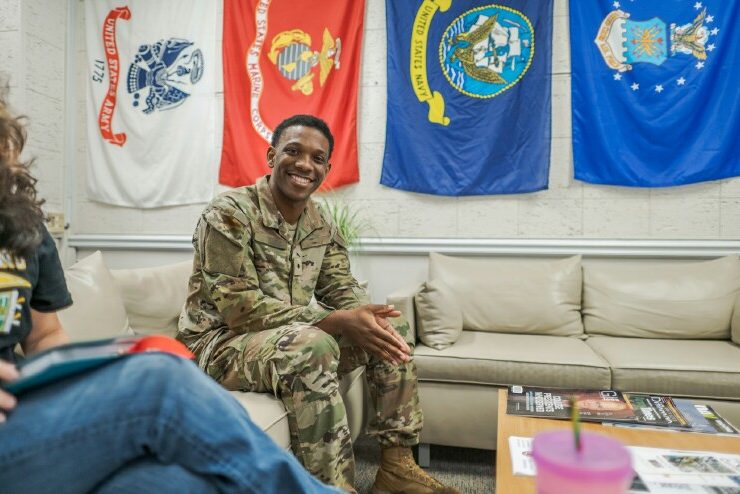
Travis Cheek ’26 did not come to Methodist University simply because he wanted to study the brain. He wanted to understand why people think the way they do, why they struggle, how they heal, and more so how he can help them. Two years into his college journey, Cheek thought he had his entire academic path mapped out for his career.
Travis Cheek ’26 did not come to Methodist University simply because he wanted to study the brain. He wanted to understand why people think the way they do, why they struggle, how they heal, and more so how he can help them. Two years into his college journey, Cheek thought he had his entire academic path mapped out for his career.
At Fayetteville Technical Community College, he was studying pre-med Biology with plans of becoming a neurosurgeon. He was intrigued by the brain, its complexity, the way it holds memories and attention, and controls decisions. He knew he wanted to work in medicine, and he knew he wanted to work with the mind.
After completing two years at FTCC, Cheek transferred to Methodist University to continue his studies and pursue a four-year bachelor’s degree. His transition to MU would completely shift what he thought he wanted for his career path.
Now, a senior Psychology major at Methodist University with a concentration in Clinical Counseling, Cheek minors in Military Science and Cognitive Behavioral Neuropsychology, with a long-term goal of becoming a psychiatrist focusing on addiction treatment.
“I wanted to work with the brain,” he said. “Memory, attention, decision-making, the subtle aspects of how we function. That was the true appeal to me.”
A theory of personality course taught by Assistant Professor of Psychology Laura Mars, Ph.D., made Cheek question what he thought he wanted. He became inspired by thinking about how experiences shape how people think and behave, rather than focusing solely on the biological structure of the brain.
“We like to attribute people’s behavior to whatever we might do” he said, “but we don’t really take into account what that person has gone through all the way up until that point in their life.”
From that realization, Cheeks’ journey at MU continued. He switched majors from Biology to Psychology. Psychology bridged the study of sciences and human lived experiences, while his neuropsychology minor gave him the opportunity to continue exploring the brain and stay on track with his medical school prerequisites.
“Travis is an awesome student who has taken a leadership and mentorship role in the senior research seminar as well as the neuroscience classes,” said Katherine Snyder, Ph.D., a professor of Psychology. “I’m looking forward to inducting him into the Psi Chi International Honor Society in Psychology this year. I have no doubt that he will go far in the field of psychology and be an asset to his future clients.”
Keeping up with a Psychology major and two minors require discipline and structure, the type of structure he learned in the Army. Through the Army ROTC Green to Gold program at Methodist University, Cheek is preparing to commission as a second lieutenant while completing his degree. It is the type of dedication that requires consistency, discipline and leadership, all qualities Maj. Steve Royse, instructor of Military Science, says Cheek embodies.
“Travis has been a strong contributor to Army ROTC at Methodist University through the Green to Gold program, as well as an active member of the National Guard through the Simultaneous Membership Program, he consistently demonstrates professionalism, reliability, and a genuine desire to improve as both a student and a future Army officer,” Royse said.
That same discipline influences how he approaches mental health and the people he hopes to serve one day. In the military, strength is often measured by resilience. In psychology, he has learned that strength can also mean vulnerability.
“I think there used to be a stigma, but we’re lifting the veil on that,” he said. “Asking for help shouldn’t feel like being a burden.”
At Methodist University, what began as an interest in the brain has grown into a dedication to understanding people and serving others. A single class gave Cheek a fresh perspective and changed the way he thought about people and the world around him. Just a week away from being inducted into the Psi Chi International Honor Society, he’s preparing for graduation and the next chapter of his life − taking the MCAT to eventually attend the Methodist University Cape Fear Valley Health School of Medicine, applying what he’s learned in Psychology, building on insights from neuroscience, and carrying forward his commitment to serve.