Part 1: Patient Care
Choosing a medical school is one of the most important decisions a future physician will make. Students seek a program that not only prepares them academically, but prepares them to become practice-ready clinicians capable of serving the needs of Southeastern North Carolina and beyond.
As North Carolina’s newest LCME-accredited medical school, the Methodist University Cape Fear Valley Health School of Medicine – which is taking applications now for its first class in the summer of 2026 – will prepare graduates to become socially accountable, community-engaged, evidence-based, compassionate, and equity-focused physician leaders who help reduce health disparities and improve health outcomes. Its vision is to shape a model of community-engaged health promotion and exceptional healthcare for today’s and tomorrow’s health landscape.
This four-part series highlights what distinguishes the program, beginning with its approach to patient care.
Early Hands-On Learning
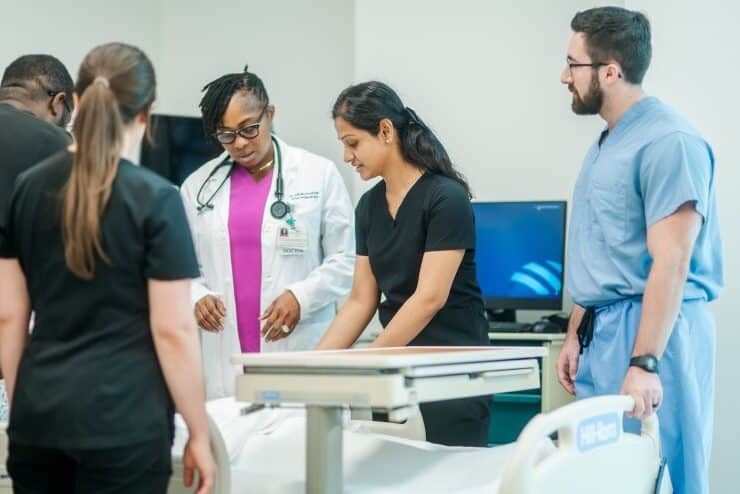
At the Methodist University Cape Fear Valley Health School of Medicine (SOM), patient care will be a major part of the curriculum from the start. Students will engage in clinical learning during their first month through standardized patient encounters, simulation-based training, and the introduction of foundational procedural skills.
“Procedural skills are integrated into the curriculum from the very beginning,” said Dr. Elizabeth Gignac, assistant dean for Clinical Skills & Simulation. “During the first semester, students will learn how to splint fractures, give injections, start IVs, perform point-of-care ultrasound, and a number of other procedures.”
In addition, skills-based practices such as naloxone administration and Stop the Bleed will reinforce classroom instruction through applied patient care scenarios. Together, these early clinical experiences help develop the mindset to think like physicians from Day 1.
Clinical Presentation Curriculum
The curriculum at the new SOM is intentionally patient focused and tailored to the health needs of Southeastern North Carolina. Students will engage with material through clinical scenarios that reflect how patients see care within the community. This allows students to integrate scientific knowledge with clinical reasons, continuing to build on the foundational mindset for physician-minded thinking.
The curriculum will be delivered through three phases, each progressively building upon the last.
Phase 1: Foundational (Didactic)
During the Foundational Phase, students will study integrated clinical sciences, health systems, and clinical reasoning through the lens of patient clinical presentations. The curriculum emphasizes how diseases develop, including microbiologic changes and basic pharmacology related to commonly administered medications. Rather than solely memorizing concepts, they will see how these ideas apply to patient care.
For example, in a dermatology unit, students may review short lessons on the anatomy and physiology of the skin, related microbes, and basic pharmacology related to commonly administered medications, such as ointments and steroids. Students will learn how foundational concepts directly impact patient care decisions. Through facilitated patient scenarios, students will be immersed in the full scope of patient evaluation. They will analyze symptoms, diagnosis, and develop treatment plans.
As Gignac explains, “Each element of the curriculum has been carefully crafted to integrate clinical thinking into patient care.”
This approach ensures students not only learn the core concepts, but also understand how to apply them in clinical contexts.
Phase 2: Cornerstone (Clinical)
In the Cornerstone Phase, instruction occurs, more so within clinical environments. Students will build their education beyond the classroom into settings including, but not limited to: hospitals, outpatient offices, emergency departments, nursing facilities, and ambulatory care settings. These experiences will allow students to observe and participate in patient care across diverse healthcare contexts.
During third-year clerkships, students will incorporate their foundational sciences and clinical reasoning skills into real patient encounters. Clerkships and dedicated didactics are intentionally aligned to reinforce learning objectives specific to this stage of training. Students will rotate through required disciplines including family medicine, internal medicine, pediatrics, obstetrics and gynecology, psychiatry, geriatrics, neurology, surgery, emergency medicine, and ambulatory medicine.
This phase emphasizes the progression between classroom knowledge and clinical practice while preparing students for individual responsibility in patient care.
Phase 3: Capstone (Advanced Clinical)
In the Capstone Phase, students will apply their cumulative knowledge and training through advanced clinical rotations and direct patient care. These experiences support residency readiness and strengthen the local healthcare workforce pipeline. Graduates will leave the program prepared to serve as confident, community-engaged physicians equipped to meet the evolving needs of Southeastern North Carolina.
To learn more about the full curriculum, visit clinical presentation curriculum. For more information on admissions, upcoming deadlines, and events visit methodist.edu/academics/medicine/.
Next In Our Series: Scholarly Research
In Part 2 of our series, we’ll explore how the Methodist University Cape Fear Valley Health School of Medicine will empower students in scholarly research and inquiry. Teaching them to gather data, interpret it, and present findings to address health challenges in the communities they serve.