School of Medicine: Curriculum
Curriculum Overview
At the Methodist University Cape Fear Valley Health School of Medicine, the curriculum is designed to support students’ growth as compassionate, evidence-informed future physicians who understand the needs of patients and communities.
The curriculum is a four-year, competency-based curriculum that prepares students to care for patients, reason through complex clinical problems, and serve communities. It is organized into three phases: Foundation, Cornerstone, and Capstone. Students begin by building foundational science, clinical reasoning, communication skills, and early clinical skills through structured learning experiences. They then move into supervised clinical learning experiences within Cape Fear Valley Health and related care settings.
Throughout the curriculum, students engage with patient-centered clinical presentations, active learning, health systems concepts, community health perspectives, feedback, reflection, and scholarly inquiry.
Curriculum Progression
Students move from foundational knowledge and early clinical skill development, to supervised clinical learning, to advanced preparation for residency.
| Foundation Phase Years 1-2 |
Cornerstone Phase Year 3 |
Capstone Phase Year 4 |
|
|---|---|---|---|
| Students build foundational science knowledge, clinical reasoning, communication skills, and early clinical skills through integrated learning experiences. | Students apply knowledge in supervised clinical settings through clerkships, patient care experiences, feedback, and longitudinal medical education. | Students complete advanced clinical experiences, acting internship, electives, interviews, and preparation for the transition to residency. | |
Year 1 |
Year 2 |
Year 3 |
Year 4 |
| Orientation | Advanced Systems Courses | Clerkships
|
Acting Internship |
| Principles & Foundations of Medicine | Behavioral Science | Selectives / Electives / Away Rotations | |
| Integrated Body Systems Blocks | USMLE Step 1 Preparation | Interviews | |
| Optional Elective | USMLE Step 2 CK Prep & Exam | Graduation / Transition to Residency | |
| Bridge to Clerkships | Longitudinal MedEd | ||
| Clinical Skills | Health System Sciences | Empowering the 910 Longitudinal experiences integrated through Years 1–2, including Empowering the 910: Bridging Health Disparities. |
|||
| Longitudinal experiences, patient care, feedback, reflection, and professional development are connected across the curriculum and integrated throughout all four years, so students can build competence over time. | |||
Patient-Forward Curriculum Model
The patient-forward curriculum integrates foundational, health systems, and clinical sciences; clinical reasoning and skill development; team-based active learning; and common clinical presentations.
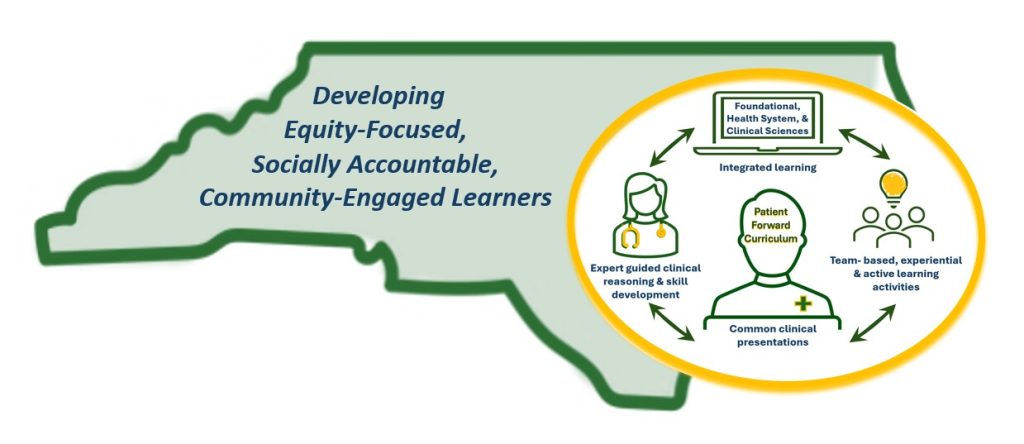
| Rooted in Community. Focused on Health Equity. | |
|---|---|
| This model supports equity-focused, socially accountable, community-engaged learning for future physicians. | |
| Integrated Sciences | Clinical Reasoning & Skills |
| Foundational, health systems, and clinical sciences are connected through integrated learning. | Students develop clinical reasoning and skills through guided practice, cases, and application. |
| Team-Based Active Learning | Common Clinical Presentations |
| Students apply knowledge through collaborative, experiential learning activities. | Learning is organized around clinical presentations and problems students are likely to encounter in practice. |