
AI Literacy
The AI Literacy minor offers students across all majors the opportunity to build a foundational understanding of artificial intelligence in a non-technical, accessible format. Courses focus on practical skills, ethical insight, and real-world applications of AI across fields including business, media, social science, and the arts.
Common Career Paths
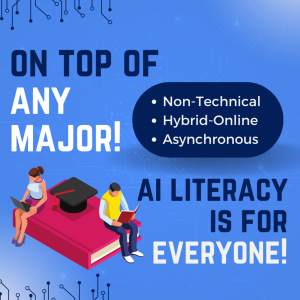 Given that this program is non-technical and is beneficial to be added to any major, it opens the door to a diverse array of job opportunities. Graduates are professionals in other fields who have learned to leverage AI to enhance their work. Some examples include:
- Health Care Administration + AI Literacy = Clinical Information Specialist
- Education + AI Literacy = Digital Learning Coordinator
- Marketing + AI Literacy = Digital Media Specialist (Business)
- Pre-Law + AI Literacy = AI Compliance Officer (Legal)
For more information on these career outcomes, see Careers in AI Literacy.
Common Salary Benefits for Graduates
AI Literacy is a world brimming with opportunity, and it can be added to any major and be applicable in any industry. As such, there is a great opportunity for future earnings beyond those without AI experience.
- 90% of employers expect to use AI solutions by 2028
- 73% of employers say that it’s a priority to hire AI talent
- Employers are willing to pay 35% more for employees with AI expertise
Average Tuition Cost
The average cost for an incoming residential freshman to attend MU is less than $18,000 – similar to the cost of attending one of the big-box public schools, but with the enhanced value of a highly-regarded private school with a 12:1 student-to-faculty ratio.
While tuition varies, depending on a student’s financial aid package, it’s important to know that the average financial award for an incoming residential freshman at MU is more than $34,000.
Financial Aid & Scholarships
More than 97% of MU students receive some form of financial aid, with the University offering more than $24 million annually to students for scholarships. If a student is active military, family of active military, or a veteran, they may also qualify for MU’s military education benefits.

Interested in Methodist University’s AI Literacy minor?
If you have questions, reach out to Dr. Sonali Kudva using the contact info at the bottom of the page. If you’re ready to apply today, visit the link below!
Minor Requirements
The minor in AI Literacy consists of 15 credits, distributed as follows:
| CME 1100 AI for Everyone (3) | CME 2200 UX I: Understanding User Experience (3) |
| CME 2100 AI for Decision-Making (3) | CME 3210 AI Ethics (3) |
| CME 2110 AI for Creativity and Design (3) |
This minor is offered online through a consortium of accredited colleges and universities. All courses within the program are delivered by faculty employed by partner institutions in the consortium, with technology and administrative support provided by Rize Education. Oversight of courses offered through the consortium are reviewed and approved by Methodist University. Students register through Methodist University and receive academic credit from Methodist University.
Frequently Asked Questions
The AI Literacy program is built for students who want to learn how AI works and develop the fundamental skills needed to leverage this technology in their future careers. This program is ideal for everyone who wants to gain a skill set in AI and is not limited to those pursuing technical degrees.
After completing the AI Literacy program, students can enter a broad range of fields, applying AI to enhance their work. Potential examples include healthcare administrators using AI for patient data analysis, educators integrating AI in teaching methods, creative professionals like authors or artists employing AI in their creative processes, legal professionals optimizing legal workflows, and government officials improving public services through AI.
This program is designed to help students become more effective in their future roles, rather than find careers in AI specifically. The skills learned in these courses will be broadly applicable.
The program minimizes prerequisites to encourage wide participation. A basic familiarity with using computers and managing data formats is expected, ensuring students can engage effectively with the program’s content. However, students do not need any coding experience or a background in AI.
The AI Literacy program equips students with versatile skills applicable across various industries. Understanding AI can enhance one’s ability to innovate, make data-driven decisions, and stay relevant in a rapidly evolving job market, regardless of the specific career path chosen.
Contact
Sonali Kudva, Ph.D.