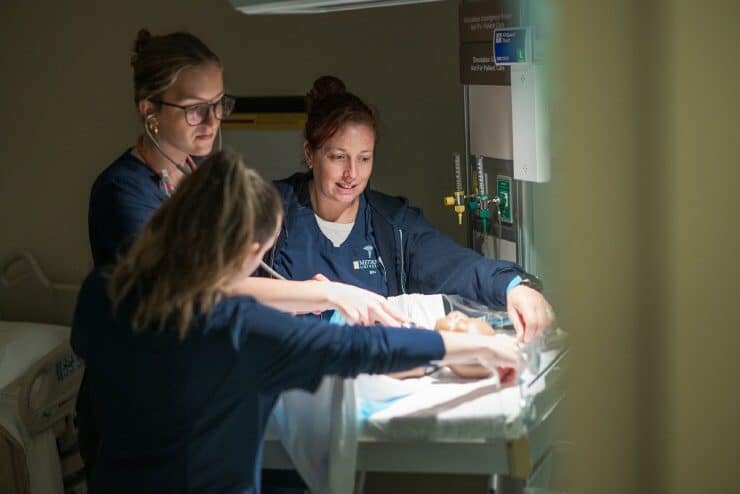
Inside the program’s state-of-the-art, on-campus nursing simulation lab, Methodist University Nursing students move through patient scenarios designed to reflect the unpredictability of clinical and emergency environments. Faculty and staff observe behind glass and monitors as students note symptoms, check vitals, develop treatment plans, and respond in real time using advanced simulation technology.
Inside the program’s state-of-the-art, on-campus nursing simulation lab, Methodist University Nursing students move through patient scenarios designed to reflect the unpredictability of clinical and emergency environments. Faculty and staff observe behind glass and monitors as students note symptoms, check vitals, develop treatment plans, and respond in real time using advanced simulation technology.
The environment and its aesthetic resemble that of the controlled chaos of a hospital floor, but it is all happening on campus, inside the Robert J. Chaffin Building, where future nurses are learning how to think, adapt, and provide care before stepping into their practice.
In recognition of International Nurses Day and this year’s theme, “Our Nurses. Our Future. Empowered Nurses Save Lives,” Methodist University Nursing faculty share how empowering futures in the field through evolving teaching styles, new technology, and added diversity are preparing students for the future of an ever-changing healthcare landscape.
Evolving Students Preparation & Teachings
 As healthcare environments continue to change, nursing education evolves with it.
“One of the most significant changes in nursing education is the shift from content-heavy instruction to competency-based education that emphasizes clinical judgment, adaptability, and professional identity formation,” said Lori Cooke, DNP, assistant professor and interim head of Nursing at MU.
Cooke says today’s nursing education requires students to develop much more than technical knowledge. Patients are presenting with multiple chronic conditions, increased acuity, mental health needs, and social determinants that directly impact outcomes.
As a result, nursing programs have begun to frame active learning strategies including simulation scenarios, case-based learning, concept mapping, and clinical reasoning exercises that require students to synthesize information rather than memorize it.
“The goal is not to replace foundational nursing principles, but rather to strengthen students’ ability to apply them effectively,” Cooke said.
Evolving Learning Through Simulation & Technology
Many hours of that preparation take place inside Methodist University’s simulation lab, where students are immersed into patient experiences and expected to deliver patient care through those experiences before entering their clinical practice. Simulation is used in nursing and health professions as experiential learning to help students and future healthcare workers bridge the gap between classroom learning and clinical practice.
“Afterwards, they go through a structured debriefing process that challenges them to reflect on their performance and ask themselves, ‘What did I do well? What could I have done better?’” said Melissa Ayscue, assistant professor of Nursing and simulation coordinator at MU.
The simulation lab incorporates a range of advanced technology designed to increase realism and strengthen clinical preparedness. High-fidelity manikins allow students to listen to lung and heart sounds, check pulses, perform CPR, and respond to emergency situations. One simulation manikin is even capable of labor and delivery.
“The greatest advancements are the ones that increase realism,” Ayscue said.
Also becoming part of the evolving nursing landscape is virtual reality and immersive AI technology that students can engage in patient care scenarios.
“Virtual reality and immersive AI are quickly gaining ground in simulation,” Ayscue said. “These technologies can provide patient scenarios in any setting and allow the student to have a natural conversation with the virtual patient, receive automatic feedback, and practice therapeutic communication.”
The faculty and staff of MU’s Nursing program say these experiences help student preparedness before entering clinical environments.
“The opportunity to have these experiences provides future nurses who are confident, adaptable, culturally responsive healthcare professionals ready to care for patients in any situation,” Ayscue said.
Evolving Faces of Nursing
As nursing education continues to evolve, faculty also say representation and diversity do too, continuing to shape the future of the profession.
Tom Johnston, assistant professor of Nursing, said he has seen increasing interest from men entering nursing programs, particularly veterans and second-career students.
“Most of the male students I see are veterans, mature adults, who realized that nursing is not what they were led to believe back in high school,” Johnston said.
Located near Fort Bragg, and with a Military and Veterans Center right on campus, Methodist University has seen its share of military-affiliated students pursue healthcare fields and nursing following careers in service, bringing a diversity of experience and perspectives into the classroom.
Johnston said stereotypes surrounding men in the field still discourage many from considering the profession.
“It is a terrible tragedy because we miss out on a lot when we stereotype professions,” Johnston said.
Johnston also mentions that diversity within nursing programs strengthens both classroom environment and the profession overall. He says that diversity in healthcare leads to broader perspectives, better collaboration, and improved outcomes for patients and organizations.
“Diversity brings strength to any organization,” Johnston said.
Through mentorship, outreach, and organizations like the MU Men in Nursing Club, continue encouraging students to consider careers in healthcare.
“Once we show them what it means to be a nurse, the preconceived barriers fall away and they see that this is a profession for men,” Johnston said.
In honoring International Nurses Day, and the faculty and staff who educate future nursing professionals, MU faculty say the future of nursing depends on preparing healthcare professionals who are not only clinically prepared but empowered to make lasting impacts on the lives of the patients and communities they serve.
For more information about Methodist University’s Nursing Program, visit methodist.edu/academics/program/nursing/.